
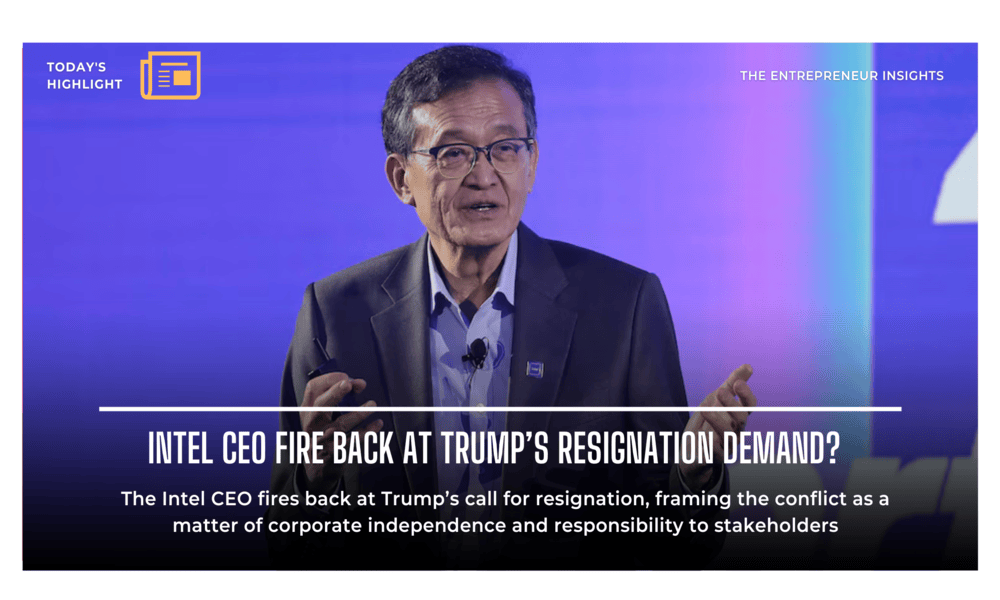
The Intel CEO responds to former President Donald Trump’s public call for his resignation. The contentious discussion has sparked debate in political and tech circles, highlighting the increasingly fraught intersection of technology leadership and partisan politics.
According to reports, Trump asked for his resignation after the CEO criticized the former president’s most recent economic plans. The Intel chairman defended his position, claiming that his comments were motivated by a desire to protect US innovation, supply chains, and worker stability rather than a political rivalry.
The Trigger Behind the Clash
According to sources, the dispute began when Intel announced a shift in its manufacturing priorities, aiming to strengthen domestic semiconductor production. Trump criticized the decision, claiming it undermined certain trade commitments and called for the CEO Lip-Bu Tan to step down.
Intel’s CEO responds with a company-wide statement, claiming that corporate decisions are made “in the best interests of shareholders, employees, and the country’s technological leadership.” Lip-Bu Tan also stated that external political pressure will not influence Intel’s operating strategy.
A Broader Debate on Politics and Corporate Leadership
This confrontation has sparked a larger debate about how corporate executives should deal with political pressures. Analysts point out that technology leaders frequently face criticism from both sides of the political spectrum when their strategies intersect with national policy.
The CEO’s position reflects a larger corporate trend: defending business autonomy while balancing government relations in a politically charged environment. Meanwhile, investors are closely monitoring any impact on Intel’s stock or public image.
Industry and Public Reaction
The incident has generated significant buzz on social media, with supporters praising the CEO for standing his ground, while critics argue that taking a public political stance risks alienating customers and policymakers.
According to industry analysts, while the dispute may cause short-term political tension, Intel’s long-term performance will be determined by technological advancements and its ability to compete globally rather than political disagreements.
The Intel CEO responds to Trump’s call for resignation, framing the conflict as one of corporate independence and responsibility to stakeholders. It is unclear whether the spat will have long-term consequences, but it highlights the delicate balance between politics and boardroom decision-making in today’s interconnected economy.













Leave a comment