
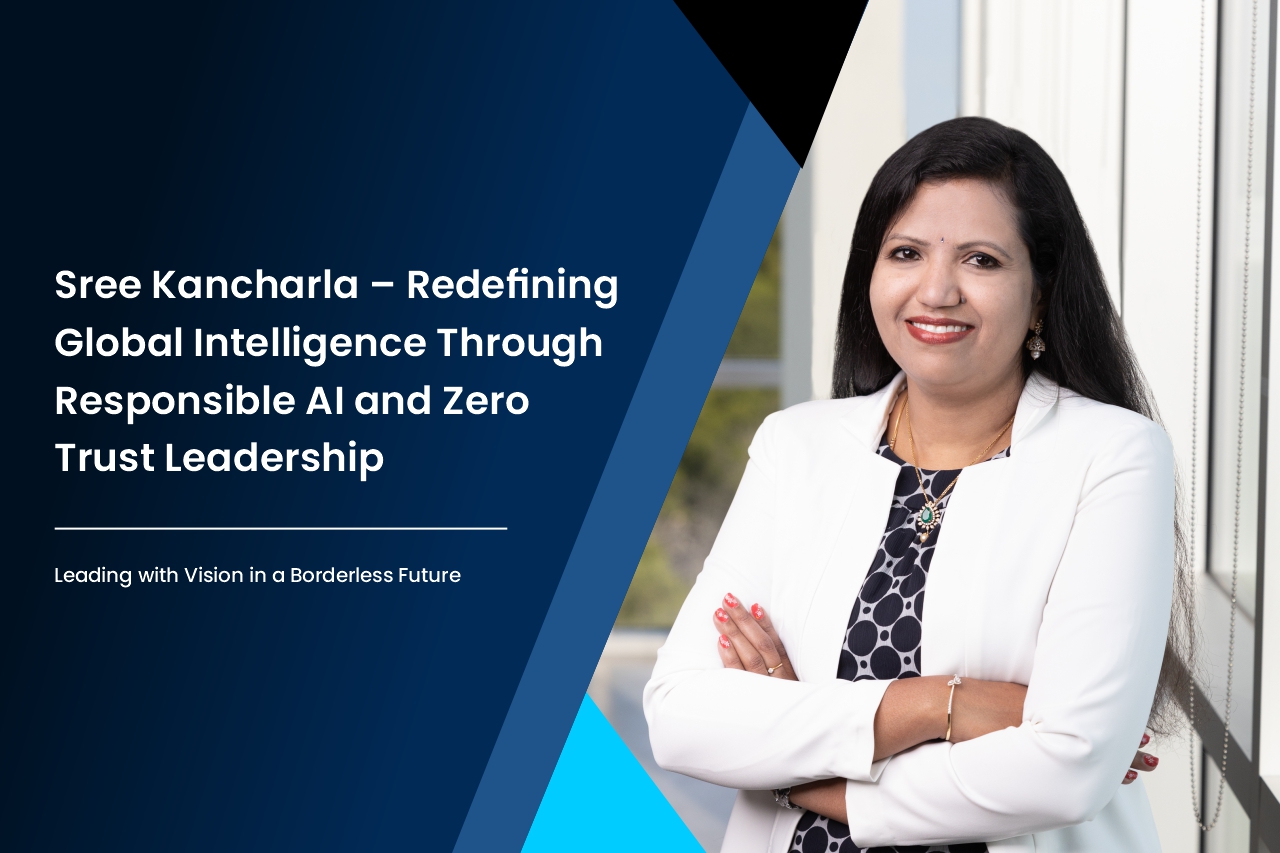
The Entrepreneur Insights Magazine proudly presents Sree Kancharla, Chief Information Officer at SailPoint, on the cover of our unique edition, “Top 10 AI Leaders Shaping Global Intelligence, 2026.” In a period where artificial intelligence is reshaping the architecture of modern companies, Sree sits at the vanguard of integrating AI innovation, identity security, digital transformation, and Zero Trust governance into a unified plan for global intelligence leadership.
Below is an in-depth and exclusive conversation, preserving each question as asked, offering profound theoretical insights into the future of AI, leadership evolution, and responsible enterprise transformation.
As a leader shaping the future of global intelligence, how do you personally define the responsible and impactful use of AI in 2026 and beyond?
As a leader shaping the future of global intelligence, my definition of AI’s use in 2026 and beyond rests firmly on two inseparable pillars: impactful AI that drives the business forward and responsible AI that secures, governs, and sustains it.
Impactful AI, from a strategic enterprise perspective, is not about experimentation or incremental automation. It is about delivering measurable influence on core business outcomes. The era of isolated pilots and superficial productivity enhancements is over. In its place, we now see the emergence of intelligent AI agents capable of executing end-to-end workflows that materially influence growth, efficiency, employee experience, and customer engagement.
True impact lies in outcomes rather than outputs. When AI reduces onboarding time significantly, shortens sales cycles through predictive intelligence, enhances customer support resolution speeds, or transforms financial workflows into touchless, auditable systems, it shifts from being a tool to becoming a business catalyst. Impactful AI must be aligned directly with enterprise KPIs, ensuring that technological sophistication translates into tangible economic value.
However, impactful AI without responsibility is unsustainable. Responsible AI is the bedrock upon which innovation must stand. As a CIO operating within the identity security domain, I view responsibility through a Zero Trust architectural lens. Every AI agent is treated as a nonhuman identity with no inherent rights. Access must be earned, time-bound, specific, and fully auditable. The principle of least privilege becomes non-negotiable.
In 2026 and beyond, responsible AI means embedding governance into architecture rather than layering it as an afterthought. Transparency, explainability, audit trails, and human oversight are not barriers to innovation; they are enablers of sustainable progress. When trust is architected into the system, organizations gain the confidence to scale AI initiatives rapidly without compromising security or ethics.
You have led digital transformation initiatives across startups and $1B+ enterprises. How has your leadership style evolved with the rapid rise of AI & cloud native ecosystems?
My fundamental leadership philosophy has remained rooted in boldness, clarity of direction, and transparent risk visibility. However, the acceleration of AI and cloud-native ecosystems has required a significant evolution in how that philosophy is operationalized.
Historically, digital transformation was guided by detailed multi-year roadmaps. With SaaS and cloud migration, long-term structured planning was both possible and effective. AI, however, evolves at a velocity that renders traditional planning models obsolete within months. As a result, my leadership has shifted from prescribing fixed roadmaps to defining strategic vectors.
Today, the focus is on setting clear and ambitious business outcomes while allowing the technological path to remain fluid and adaptive. The destination remains firm, but the route evolves dynamically as innovation accelerates. This approach requires agility, rapid experimentation, and an organizational culture that embraces iteration.
Additionally, transformation has moved from deploying large-scale monolithic projects to building modular capabilities in the form of intelligent AI agents. Leadership now involves constructing an internal “agent factory” — a centralized AI platform that allows continuous development, testing, and refinement of digital capabilities. Value is measured in shorter cycles, and course correction is immediate when outcomes fall short.
Risk management has also transformed. AI introduces complex challenges including data bias, privacy concerns, ethical dilemmas, and brand reputation risks. Rather than addressing these issues periodically, governance must operate at the speed of AI itself. Automated policy enforcement, identity-centric controls, and continuous monitoring have replaced traditional review mechanisms.
Finally, leadership in the AI era demands humility and orchestration. No single leader can master every emerging AI discipline. The role has evolved into that of a strategic conductor — aligning diverse technical expertise under a unified business vision. Creating psychological safety for experimentation while maintaining strategic clarity defines modern technology leadership.
What core technical, analytical, and human centric skills do you believe professionals must develop today to remain relevant in an AI powered future? And how do you strike a balance between automation, AI driven efficiency, and preserving the human element at work?
The AI-powered future requires professionals to cultivate a triad of competencies that extend beyond traditional technical proficiency.
Technically, individuals must develop AI fluency. This does not necessarily imply deep algorithmic development skills but rather the ability to orchestrate AI systems effectively. Understanding prompt engineering, platform integration, data governance, and API ecosystems becomes foundational. Every professional must recognize their responsibility as a steward of enterprise data.
Analytically, human value shifts toward interpretation. AI excels at identifying patterns and processing data at scale, but it cannot independently contextualize implications within broader strategic frameworks. Professionals must sharpen critical thinking skills, validate AI outputs rigorously, and translate insights into actionable business decisions. The ability to ask the right question becomes more valuable than simply generating answers.
Human-centric skills become even more critical. Emotional intelligence, adaptive leadership, strategic communication, and continuous learning form the cornerstone of relevance in an automated world. As routine tasks diminish, uniquely human capabilities — creativity, empathy, negotiation, mentorship — rise in prominence.
Balancing automation with human judgment is not about trade-offs but about intelligent augmentation. Automation should eliminate repetitive and data-intensive tasks, while humans retain authority over strategic, ethical, and complex decisions. A “human-in-the-loop” design philosophy ensures oversight remains intentional rather than symbolic. The ultimate objective is not workforce reduction but workforce elevation — enabling professionals to focus on higher-order contributions that drive innovation and sustainable growth.
How do you strike the right balance between AI driven efficiency, automation, and preserving human judgment, ethics, and trust within organizations?
The concept of balance suggests competition between efficiency and ethics. In reality, they are mutually reinforcing when architected correctly.
First, organizations must establish clear boundaries distinguishing automation from judgment. AI systems are exceptionally capable of handling large-scale information processing and structured workflows. However, ethical interpretation, contextual nuance, and final decision-making must remain human responsibilities.
Second, efficiency gains should be reinvested into human capital development. AI-driven productivity creates space for strategic planning, creative problem-solving, and cross-functional collaboration. When employees see technology enhancing their roles rather than threatening them, trust is strengthened.
Third, trust must be engineered through design. Zero Trust identity principles, transparent data flows, auditable algorithms, and explainable AI models build institutional confidence. Ethical guardrails embedded at the architectural level ensure that compliance and responsibility scale alongside innovation.
Ultimately, preserving human judgment is not about resisting automation but about ensuring that automation amplifies human capability rather than replaces human accountability.
How do you see remote and hybrid work models transforming productivity, collaboration, and leadership accountability?
Remote and hybrid work models have shifted productivity measurement from presence-based observation to outcome-based evaluation. AI now enhances this transformation by providing structured insights into deliverables, collaboration patterns, and workflow efficiency.
Collaboration has evolved into a more asynchronous and intelligence-driven model. AI tools summarize meetings, document action items, and provide contextual continuity across geographies. This eliminates disparities between remote and on-site employees.
Leadership accountability becomes increasingly transparent in such an environment. With measurable performance indicators and AI-supported analytics, leadership effectiveness is assessed through tangible results rather than physical oversight. The emphasis moves toward clarity of goals, strategic alignment, and consistent delivery.
Can you share a bold decision you made that significantly influenced your organization’s growth or direction?
One defining decision in my career was leading a comprehensive digital transformation at SailPoint during the critical period preceding its IPO. Facing stringent compliance requirements and scalability demands, we initiated a ground-up rebuild of our internal application ecosystem within an aggressive timeline.
Rather than relying solely on external systems, we leveraged our own identity platform as the security backbone of the transformation, effectively becoming “Customer Zero.” This decision reinforced our confidence in our technology while demonstrating its enterprise readiness under intense scrutiny.
The success of that initiative established a secure, scalable, and compliant infrastructure that supported public market expectations. The same boldness and architectural discipline now guide our AI strategy — building a centralized, secure AI foundation capable of powering future innovation.
As a frequent speaker at CIO and CISO summits, what key insights do you believe leaders often overlook when adopting AI and cloud native technologies?
Leaders often underestimate the importance of foundational readiness. Clean, well-governed data, robust access management, and identity-centric security controls form the essential substrate for successful AI adoption.
Without strong governance, AI initiatives produce unreliable results and introduce vulnerabilities. The excitement surrounding AI capabilities must not overshadow the discipline required to secure and structure enterprise data ecosystems.
What do you see as the biggest challenge AI leaders will face in 2026, and how can organizations proactively prepare for it today?
The most significant challenge will not be technological sophistication but organizational readiness. A widening gap may emerge between AI capabilities and workforce preparedness.
Proactive preparation requires embedding workforce development into strategic planning. Upskilling initiatives, transparent communication, and inclusive change management must accompany every technological investment. Organizations that align cultural transformation with technological acceleration will maintain sustainable momentum.
What advice would you give to aspiring AI and technology leaders who want to create meaningful impact and shape the future of global intelligence?
Aspiring leaders must anchor themselves in business value before technological fascination. Solving real enterprise challenges must precede experimentation with emerging tools.
Additionally, leadership in the AI era requires cultural stewardship. Guiding teams through uncertainty, fostering adaptability, and communicating vision clearly are as critical as technical expertise.
Most importantly, trust must be architected from inception. Zero Trust governance, transparency, ethical foresight, and auditable systems define sustainable intelligence. Leaders who integrate responsibility into innovation will earn the credibility to move faster and shape the future of global intelligence with confidence.












Leave a comment