
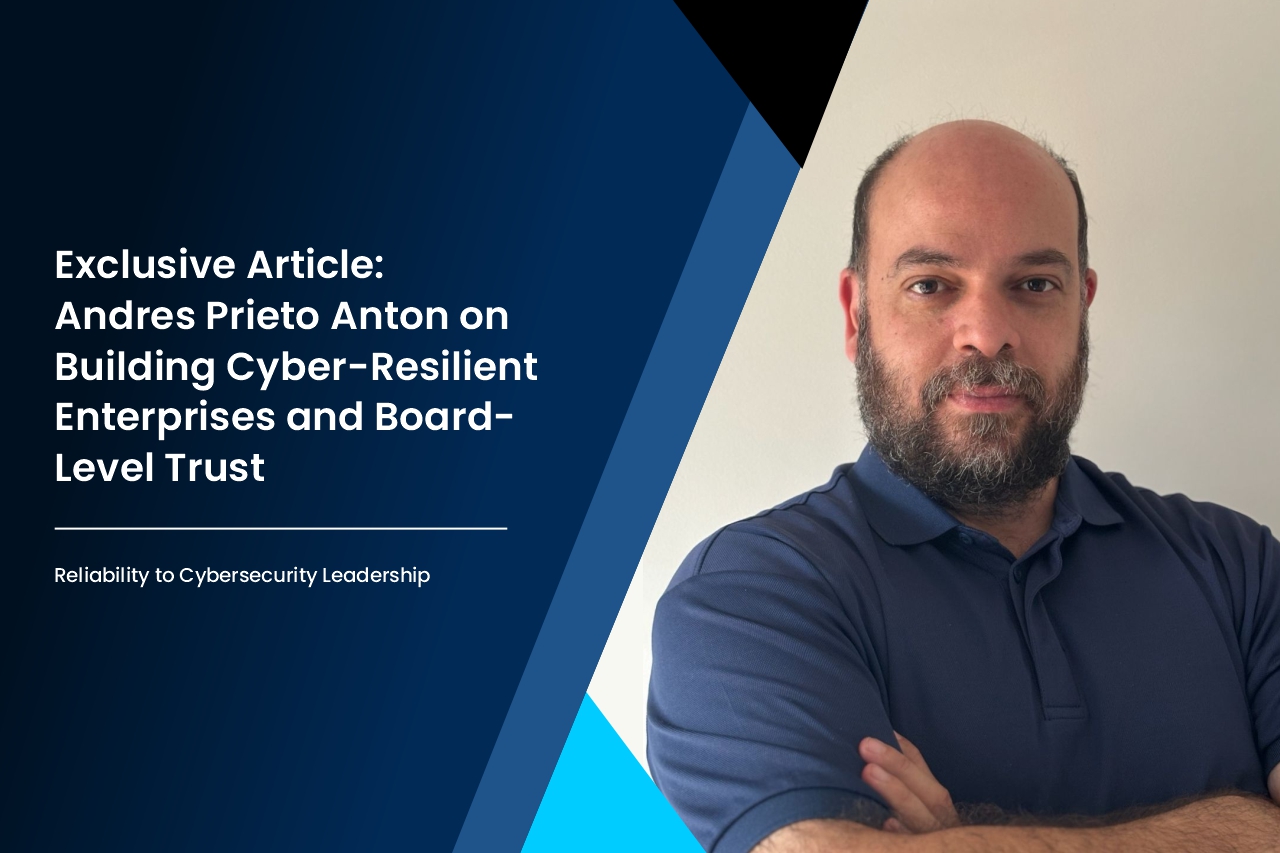
We are pleased to include Andres Prieto Anton in our new special edition, which highlights the Top 05 Cybersecurity Thought Leaders and Board Visionaries for 2026. In an era when digital trust, operational resilience, and cyber-physical security define company success, Andres Prieto Anton. Manager D&t Infra & Ot at DSM-Firmenich Cyber Security stands out as a leader who seamlessly integrates technology, business strategy, and people-centered leadership.
His career reflects a rare combination of deep operational expertise, global cybersecurity leadership, and board-level strategic influence, making him one of the most respected voices shaping the future of IT and OT cybersecurity governance worldwide.
From Infrastructure Reliability to Cybersecurity Leadership Excellence
Andres Prieto Anton’s journey into cybersecurity was not a sudden pivot but a natural evolution shaped by real-world operational accountability. Beginning his career as a systems administrator and engineer, he was entrusted with maintaining business-critical environments where downtime translated directly into financial loss and reputational damage.
As manufacturing and industrial environments grew increasingly interconnected through automation, Industrial IoT, and digital transformation, his responsibility expanded beyond uptime into enterprise-wide risk protection. This progression ignited his focus on cybersecurity as a strategic discipline—one that safeguards not only systems but also business continuity, safety, and trust.
Leading large-scale infrastructure transformation initiatives further shaped his leadership philosophy. These experiences reinforced that people, communication, and alignment are just as critical as advanced technology. His later work in global OT security programs and digital factory initiatives positioned him as a key advocate for standards such as IEC 62443, not as compliance burdens, but as enablers of resilient and scalable innovation.
Defining the Future of Cybersecurity: A Boardroom Imperative
The future of cybersecurity, as defined by Andres Prieto Anton, is driven by convergence, intelligence, and accountability.
The once-clear boundary between IT and OT environments is rapidly dissolving. Cloud integration, edge computing, and smart industrial systems have created expanded attack surfaces, making OT cybersecurity a core enterprise risk rather than a niche technical concern. Boards must now treat cyber risk with the same rigor as financial, operational, and regulatory risks.
Artificial Intelligence represents a dual-edged force—empowering defenders with predictive analytics and automation, while simultaneously enabling more sophisticated ransomware, supply chain attacks, and targeted intrusions. Understanding and governing this duality is becoming a critical board responsibility.
Equally significant is the rising expectation of executive and board-level accountability. Cybersecurity oversight is no longer delegable; it is embedded within enterprise governance frameworks, regulatory scrutiny, and investor confidence. Over the next three to five years, organizations will face increasing pressure to adopt resilience-by-design architectures, integrate cyber risk into enterprise decision-making, and recognize cybersecurity investment as a strategic enabler of innovation and trust.
Guiding Principles of a Cybersecurity Executive and Board Advisor
Andres Prieto Anton’s leadership philosophy is grounded in four guiding principles that consistently drive measurable outcomes:
- Business Alignment: Every security initiative must protect people, ensure uptime, reduce risk, and enable innovation.
- Pragmatic Defense-in-Depth: While perfect security is unattainable, layered defenses and robust incident response significantly reduce impact.
- Radical Transparency: Honest communication about risks and failures builds trust at every organizational level.
- People-First Leadership: Empowered, diverse teams and strong relationships with operations are the strongest security controls.
This approach positions cybersecurity not as a constraint, but as a strategic business function.
Transforming Board-Level Cyber Risk Understanding
Andres’ role has evolved from technical translator to strategic cyber risk advisor. Early engagements focused on explaining vulnerabilities and compliance status. Today, his advisory work centers on quantifying cyber risk in business terms—financial exposure, production downtime, safety implications, and reputational impact.
Boards no longer seek technical minutiae. They demand clarity, options, and ownership. By integrating cybersecurity into enterprise risk management frameworks, using scenario-based models and decision matrices, Andres enables boards to own cyber risk with confidence.
Technologies Reshaping Cybersecurity Strategy
Several technologies and methodologies are redefining cybersecurity under Andres’ strategic lens:
- AI and Machine Learning for real-time threat detection and response automation
- Zero Trust Architectures emphasizing continuous verification and least privilege
- Industrial IoT, Digital Twins, and 5G expanding visibility and resilience testing
- MITRE ATT&CK for ICS to standardize threat modeling
- Cyber-Physical Resilience Engineering to protect interconnected environments
Together, these tools enable organizations to move from reactive defense to predictive resilience.
Securing Global Manufacturing at Scale
One of the most impactful challenges Andres navigated involved securing globally distributed manufacturing plants during a rapid digital transformation. Balancing innovation with legacy OT systems and minimal downtime required disciplined strategy and execution.
By anchoring security programs to IEC 62443, implementing phased patching prioritized through Business Impact Analysis, and investing in network segmentation and visibility, his team established a consistent global security posture. The result was reduced incident risk, protected operational continuity, and sustained business growth.
Elevating Cyber Risk to Strategic Decision-Making
Andres employs a four-element framework to elevate cyber conversations:
- Context aligned to enterprise objectives
- Scenarios translating threats into business outcomes
- Options presenting clear risk-investment trade-offs
- Ownership embedded within governance and escalation models
This structure transforms cybersecurity from a technical discussion into board-actionable strategy.
Embedding Cybersecurity into Organizational DNA
Andres’ leadership continues to revolve around cultural development. By stressing co-creation with operations, constant education, realistic simulations, and proactive behavior recognition, cybersecurity becomes a shared organizational value that is integrated into design, procurement, and daily operations.
Global Threat Trends Demanding Immediate Action
Ransomware targeting OT environments, double-extortion methods, supply chain compromises, and AI-driven assault acceleration all contribute to the growing threat landscape. Enterprises must recalibrate defenses by improving asset visibility, segmentation, identity governance, supplier vetting, and, most importantly, resilience planning.
Closing the Cybersecurity Talent and Diversity Gap
Addressing the talent gap requires expanding beyond traditional pathways. Andres advocates for cross-disciplinary recruitment, structured mentoring, rotational programs, and intentional diversity initiatives. Continuous upskilling is no longer optional—it is foundational to sustainable cybersecurity excellence.
Three Critical Actions for Modern Boards
Modern boards must:
- Establish formal cybersecurity governance structures
- Demand business-aligned metrics and scenarios
- Empower leadership with authority, accountability, and resources
Cybersecurity must be viewed as long-term value protection, not discretionary spend.
A Legacy of Resilient Infrastructure and Future Leaders
Andres Prieto Anton, a top cybersecurity thought leader, wants to leave behind secure, flexible industrial ecosystems and a new generation of leaders who understand technology, business, and human leadership. His current priorities include expanding worldwide OT security programs, teaching future executives, and ensuring that innovation and security coexist.
“The Entrepreneur Insights” Perspective: Why Andres Prieto Anton Defines Cyber Leadership in 2026
At “The Entrepreneur Insights,” we recognize Andres Prieto Anton as a defining force in modern cybersecurity leadership. His ability to translate complexity into clarity, align cyber risk with enterprise value, and champion resilience across global operations sets a benchmark for executives and boards worldwide. In 2026 and beyond, his vision exemplifies what it means to lead securely in a hyperconnected world.
Read this digital edition now on our website.









Leave a comment